
Featuring
Opal
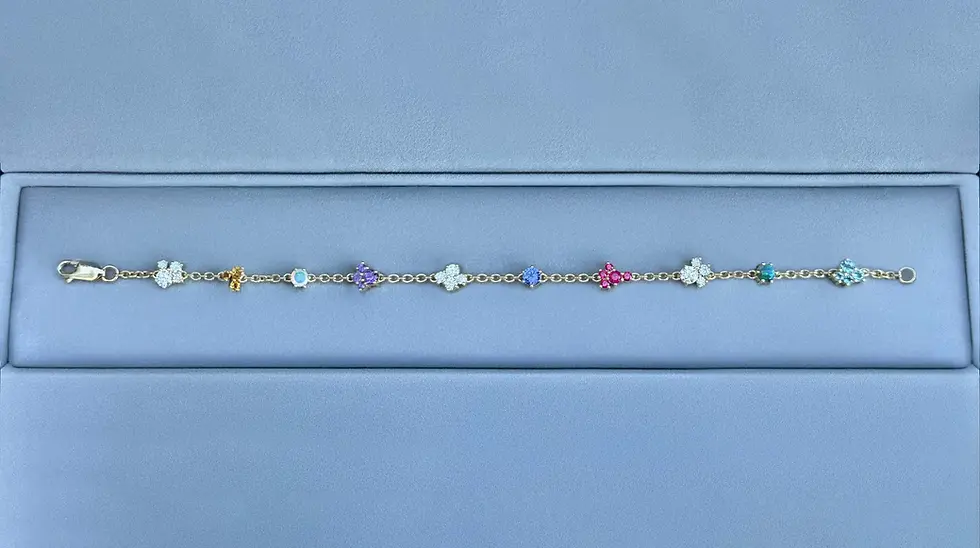
40th Wedding Anniversary Cluster Bracelet

Aquamarine and Australian Sapphire Cluster Earrings with Cartilage Stud
Moh's Hardness Scale
5.5 - 6
Birthstone
October
Anniversary
14th
As the temperature above ground heats up again, the water evaporates, leaving the silicon dioxide molecules behind that eventually (this process takes millions of years) form precious Opal. Due to this process, no two opals will ever look alike, as it’s a completely randomised deposit, and each composite of silica molecules will refract the light differently. Because of its chemical makeup, Opal has a relatively low density, so larger sizes are still light on the Carat scale.


Opal
Precious Opal displays an incredible play-of-colour, meaning it shows a variable interplay of its internal colours. Opal consists of 0.2 micron sized spheres of silicon dioxide molecules, arranged in close knit grid like patterns. As light travels between these microscopic spheres, it refracts into all the colours of the rainbow, and this is what causes the unique play-of-colour. In certain dessert conditions, such as the Outback of Australia, the silica molecules are deposited in the wet rainy season, as it trickles down through the rock formations.
